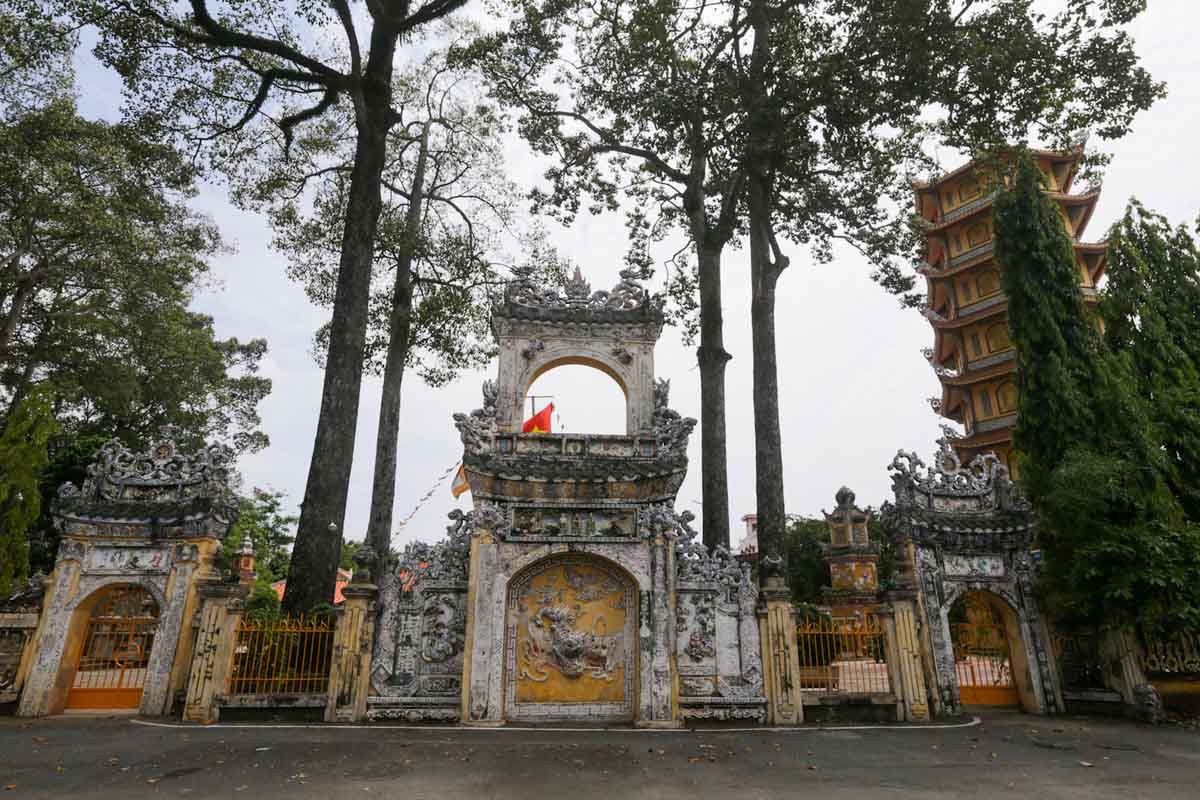
Hội Khánh pagoda, which is located in Thu Dau Mot city, is the oldest and largest religious construction of Binh Duong. On 7th January, 1993, Hội Khánh pagoda was recognized as National historical-cultural relics by the Ministry of Culture, Sports and Tourism. In May 2013, the Asian Record Organization officially established the lying Buddha statue at the pagoda as “The Buddha statue of Nirvana on the longest temple roof in Asia”.
Hội Khánh pagoda was constructed in 1741; however, it was burnt down during the war period in 1861. Then in 1868, the pagoda was rebuilt and has stood there up to the present. In 2007, the 7-floor tower with the height of 27m was added and reconstructed the Buddhism event of “Tu dong tam” (the four caves of the heart), including Bo De Dai Trang (the place where the Buddha implemented Buddhism), Lam Ti Ni Garden (the garden where the Buddha was born), Loc Uyen Garden (the place where the first Buddhism theory is born), Ta La Song Tho (the place where the Buddha entered nirvana). All of these represent details of great depth about Buddhism.
Especially, the pagoda is not only of great importance in Buddhism but also involves a lot of historic meanings. This area connects closely to the revolutionary activities of Nguyen Sinh Sac (the father of President Ho Chi Minh). During1923-1926 period, Hội Khánh Pagoda had been a hiding place used to establish the Association of Honor by Nguyen Sinh Sac together with Phan Dinh Vien and monk Tu Van. After the August Revolution in 1945, Hội Khánh pagoda became a facility of Thu Dau Mot Provincial Buddhist Association of Nation Saving. Since 1953, the pagoda had been a facility of the local association of Buddhism and then in 1983, it became the facility of the Buddhist Association in Binh Duong.
Hội Khánh pagoda consists of 5 major parts: front hall, main hall, backyard (worship area), lecture hall and East-West corridor. The campus consists of 4 architectures named after 4 relics attached to the Buddha including: Lam Ty Ni garden (where the Buddha was born); Bo De Dao Trang (where the Buddha implemented Buddhism), Loc Uyen garden (where Buddha conveyed the Wheel of turning law) and Cau Thi Na (where Buddha entered nirvana). Interiors, paintings, statues, worshiping items here are exquisitely sculpted with various matters such as the four holy beasts, nine dragons, vines, leaves, flowers,…. In spite of having undergone such many reconstructions, the pagoda still remains much of its original architecture.
Besides the 22m Buddha statue built in the front of Hội Khánh Pagoda , the ground floor also has a 64m-long and 23m-wide blocks with functions of Buddhist school, library … The great statue of Shakyamuni entering Nirvana in 12m height and 52m length is placed on the upper floor. This is a remarkable artic construction of Binh Duong Buddhism in particular and Vietnamese Buddhism in general.
Until now, Hội Khánh pagoda still retains a lot of relics such as the wooden imprinting set of Buddhism documents (considered the earliest woodblock in Binh Duong), 100 wooden statues (of very high value made by craftsmen of Thu Dau Mot, Binh Duong), the statue set of Thap Bat La Han (including 18 statues with the size of 89 – 90cm), the statue of Thap Dien Diem Vuong (including 10 statues with common size from 89 – 90 cm). In addition, there are also two sophisticated sculptures of Arhans and Bodhisattvas with high artistic value.